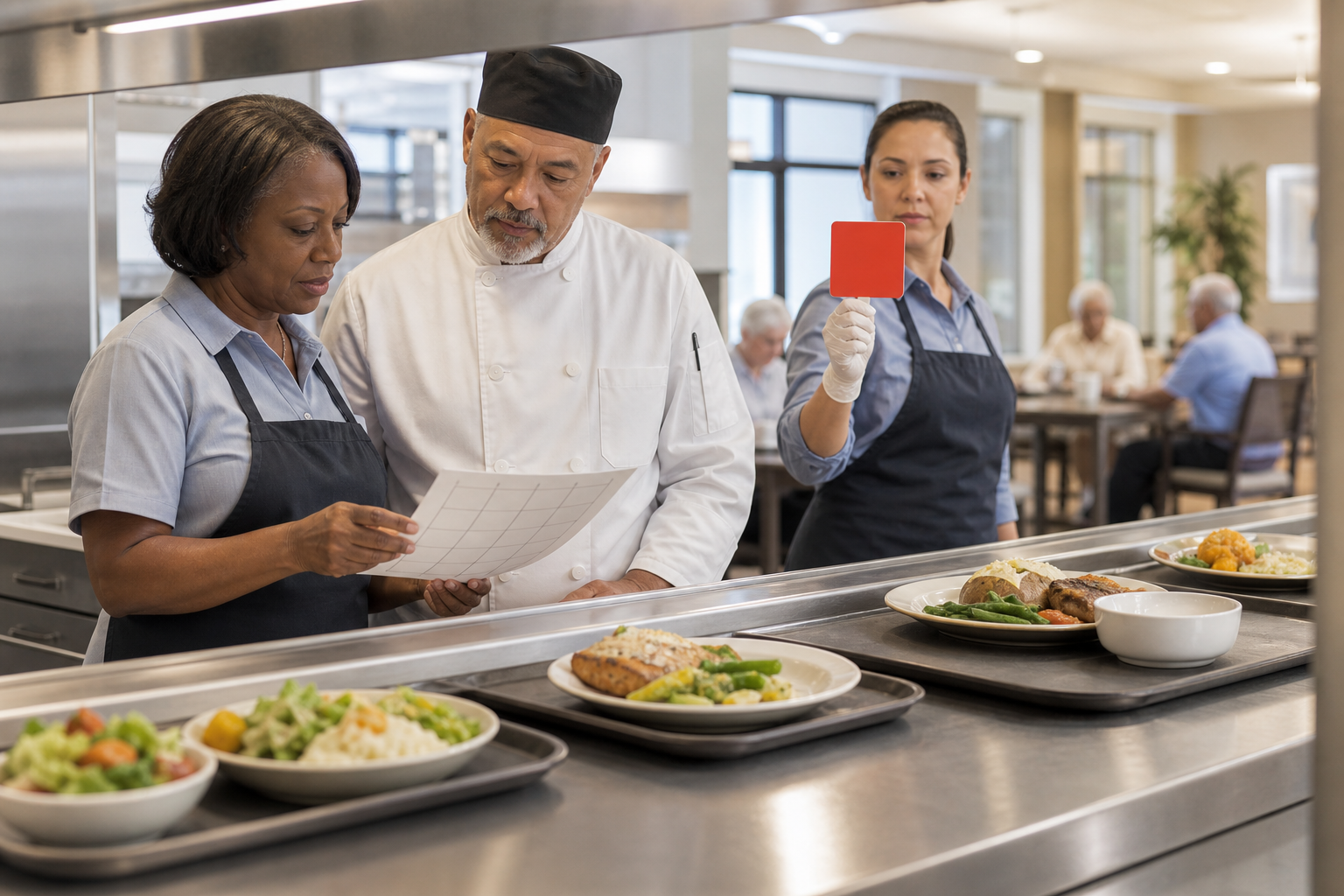
An undeclared allergen alert can turn an ordinary meal period into a high-consequence tracing problem. Senior living dining teams must stop the affected item, locate every preparation and service path, protect resident-specific requirements, select a safe substitute, and record why the tray line was allowed to restart.
A short timed exercise is useful because it tests the first decisions before a team has time to build a perfect spreadsheet. The goal is not speed alone. It is a calm, repeatable stop that leaves evidence for the next shift and a clear boundary between confirmed facts and assumptions.
Scope note
This is an operational preparedness guide, not clinical, legal, or regulatory advice. Follow official recall instructions, resident-care protocols, supplier guidance, and the community's approved food-safety and emergency procedures.
Why test the stop now
The current recall environment gives dining teams a concrete reason to rehearse. The FDA recall and safety-alert index listed a July 22 food recall involving undeclared soy, alongside other recent contamination and allergen notices. The lesson for operators is not about one brand. It is that a familiar prepared item can require an immediate ingredient-level hold.
The FDA investigation dashboard also showed multiple active July investigations. Meanwhile, the USDA July Food Price Outlook documented continued category-level price movement. That combination matters: a rushed substitution can create a second risk if availability or cost pressure causes teams to bypass the normal review.
Assign one owner to monitor official alerts and record the source, time, product identifiers, and required action. The ServingIntel operations news feed can supplement official notices, but the issuing authority and supplier remain the controlling sources.
Minute zero: issue the hold
The person who receives the alert should be able to issue a plain-language hold without waiting for a meeting. Name the item, lot or date range when known, every storage and preparation location, and what staff must not do. Preserve labels and packaging; do not discard evidence until the approved response says to do so.
Use a visible stop signal at the tray line and a matching digital or paper record. The signal should never depend on a branded screen or one manager's phone. Keep the escalation path current through the ServingIntel support workflow so culinary, resident-care, purchasing, and technical owners know who is coordinating the response.
Trace ingredients to trays
Work from receiving to service. Compare the alert with invoices, lot codes, receiving notes, storage labels, recipes, production sheets, POS menu mappings, room-service tickets, grab-and-go items, and food moved to another venue. Record each location as confirmed clear, confirmed affected, or still unknown.
Searchable purchase evidence shortens the first pass. The SI Receipt duplicate-record control is a useful companion for keeping receipts reviewable without treating a receipt as proof that a product was served.
If the system or network is unavailable, the team still needs a bounded way to reach records and continue meal service. Review the ServingIntel hardware continuity options before the exercise rather than inventing a fallback during it.
Approve one controlled substitution
Choose one culinary owner to approve the replacement and one resident-care owner to confirm resident-specific implications. Check allergens, texture, therapeutic diets, preferences, preparation capacity, and service timing. A lower-cost or readily available replacement is not automatically safe.
Record the original item, substitute, affected menu entries, approvers, effective time, and planned end condition. Connected reporting through senior living dining technology workflows can help teams compare orders and exceptions, but clinical and food-safety decisions remain with authorized staff.
Require proof before restart
Restart only when the affected item is isolated, work surfaces and tools are handled according to policy, menu mappings and labels match the approved substitute, affected trays have been identified, and the next shift has a written handoff. Name the person who releases the hold and the evidence used.
Treat the restart as a controlled operational change. The Support4POS change-window controls reinforce the same discipline: bounded scope, named ownership, validation, rollback thinking, and a durable record.
Run the seven-minute test
- Minute 1: read a fictional alert and issue the tray-line hold.
- Minute 2: identify the receiving record and product identifiers.
- Minute 3: trace the ingredient through recipes and service paths.
- Minute 4: mark affected, clear, and unknown trays or orders.
- Minute 5: propose a substitute and name both required approvers.
- Minute 6: draft the next-shift handoff and resident communication route.
- Minute 7: state the evidence required to release the hold.
Allergen stop-test checklist
- Official alert owner and stop authority are named.
- Labels, lots, invoices, recipes, and menu mappings are reachable.
- Every tray and service path can be marked affected, clear, or unknown.
- Culinary and resident-care approvals are separate and recorded.
- The substitute is checked for allergens, texture, diet, and timing.
- The restart requires evidence, an owner, and a next-shift handoff.
The bottom line: a useful allergen drill proves that the team can stop first, trace carefully, substitute deliberately, and restart only when the record supports it.